How do I stop constantly asking myself what if?
Notice when one hypothetical question starts producing another. Write down the original concern, decide whether there is a real problem requiring action, and choose one useful step if there is. If there is no new information or practical action available, leave the question unanswered for now and return to the present. You don't need to prove every frightening possibility false before you can get on with your day.
- Write down the first what-if question.
- Decide what action, if any, is useful right now.
- Let the unanswered question wait and return to today.

What if something happens to my children? What if I can't pay my bills? What if my business doesn't do well? What if I make the wrong decision? I understand how exhausting it is when your mind goes from one possibility to the next. As a mother and business owner, I've spent plenty of time worrying about things that haven't happened.
The trouble with trying to answer every what-if question is that another one may be waiting behind it. You can spend hours searching for the perfect answer and still feel uncertain. Let's look at a different way to respond.
Why does my mind keep thinking what if?
When you are uncertain about something important, thinking about possible outcomes can feel like preparation. Sometimes it is. But a question can also grow into a chain of possibilities that keeps you occupied without producing a decision.
The starting point: I haven't heard back about an important application.
First what if: What if I don't get accepted?
Second what if: What if I can't find another opportunity?
Third what if: What if I'm never able to move forward?
What has actually changed? Nothing about the application has changed in the few minutes I spent imagining all of those outcomes.
Recognizing the chain is important because you may otherwise find yourself responding emotionally to the third or fourth imagined problem as if it were already happening. My guide to expecting the worst explores how to separate predictions from facts.
Not every what-if question is unhelpful
Sometimes asking what if helps us prepare for a realistic problem. If you are traveling, considering possible delays and making a practical backup plan is sensible. But after the preparations are complete, repeatedly imagining missed flights and ruined plans may not give you any additional information.
Ask yourself whether your thinking is leading toward a decision or simply generating more questions. The NHS describes a distinction between worries you can address through action and hypothetical concerns that cannot presently be resolved.
5 ways to break the cycle of what-if thinking
1. Notice the exact question instead of following the entire story
Try saying, "I'm having the thought that something might go wrong." This creates a little distance between you and the prediction. You don't have to decide immediately whether it is true. First, recognize that you are thinking about a possibility.
2. Ask whether the question has an answer today
Some questions can be answered by checking a fact, asking an appropriate person or making an appointment. Others cannot. For example, nobody can tell you with certainty how every aspect of your life will look a year from now. Knowing the difference can prevent you from spending hours trying to answer an inherently uncertain question.
3. Replace a chain of questions with one realistic plan
Suppose you are asking, "What if I forget everything I have to do tomorrow?" Prepare a short written list. If you're asking about an actual expense, review the amount and choose one next step. Make your plan proportionate to the issue. The objective is to solve what is solvable, not construct a backup plan for every possible event. For more ideas, read how to stop worrying about things you cannot control.
4. Practice ending the thought without perfect reassurance
Imagine you have made every reasonable preparation, but your mind still asks, "Yes, but what if that doesn't work?" Try leaving the question there for a while. You can acknowledge that a particular outcome is uncertain without answering it again. For nonurgent concerns, choose a time when you will revisit the matter if needed. Always take genuine urgent health, safety and other necessary actions seriously.
5. Give your attention to something outside the loop
When you notice yourself going around in circles, consider what you were doing before the worry began. Return to that activity or choose something ordinary that matters to you. It might be reading, walking if you're able, preparing dinner or talking to someone. You can continue living while a question remains unanswered.
A practical what-if worksheet
Write down one recurring "what if" and work through these prompts:
- What is the original question my mind keeps asking?
- Has this situation actually occurred, or am I imagining it?
- Is there a realistic action I can take right now?
- Have I already made an adequate plan?
- What can I do with my attention until I have new information?
Question: What if tomorrow is a terrible day at work?
Reality: Tomorrow hasn't happened. I know there are a few responsibilities waiting for me.
Useful action: Make a short list of priorities and prepare what I need in the morning.
My response when the question returns: I've made a reasonable plan. I don't need another prediction right now.
What I can do next: Spend the rest of the evening on something I enjoy.
Your answers are not submitted or saved by this worksheet. Print a copy if you want to keep them.
The exercise is not meant to prove that nothing bad can happen. It is a way to decide when thinking has been useful enough and when you can stop feeding the loop.
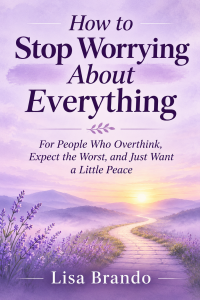
From The Finding Peace Series
How to Stop Worrying About Everything
For people who overthink, expect the worst, and just want a little peace. I wrote this book to offer practical reflections for the kinds of worry that can follow us throughout the day.
What if the what-if thoughts keep coming back?
Returning thoughts do not mean you have failed. One way to reduce the amount of attention they receive is to schedule a brief period to review nonurgent worries, as described in NHS self-help guidance. Keep a note of concerns that arise and look at them during that scheduled period. If nothing new needs action, let the note remain unanswered rather than repeating the same argument with yourself.
Practice is about changing your response, not making every worry disappear. Even recognizing a loop a few minutes earlier than you did before can be a meaningful change.
When it is time to get professional support
If what-if thoughts feel uncontrollable, cause significant distress or interfere with relationships, work, sleep or daily activities, consider talking with a healthcare provider or licensed mental health professional. Persistent worries can have different causes, and a professional can help determine which care is appropriate. Self-help exercises can complement professional support; they are not a substitute for it.
Frequently asked questions about what-if thoughts
What is the difference between worrying and problem-solving?
Problem-solving uses available information to identify and take a useful action. Worrying may repeatedly imagine possible difficulties without providing a new decision or practical solution.
Can I stop the thoughts by trying not to think about them?
Trying to force every thought away can become another struggle. Instead, notice the thought, decide whether it warrants action and gently return your attention to the task at hand.
Does constant what-if thinking mean I have anxiety?
It can accompany anxiety, but it is not enough to determine whether someone has an anxiety disorder. A qualified professional can evaluate symptoms and their effect on daily life.
What can I say to myself when the questions won't stop?
Try: "I don't know what will happen yet. If there is a useful action, I'll take it. I don't have to answer every possible question before I can continue with my day."
How do I stop asking what if at night?
Write down one concern and a reasonable next step for tomorrow, if one is needed. Set the note aside and choose a quiet activity. If worry often interferes with sleep, seek professional advice. Read my guide to overthinking at night for more encouragement.
Can preparing for the worst make me worry more?
Reasonable preparation can be useful. If you have already made a workable plan and keep generating new imagined emergencies without new information, it may be time to pause and return to the present.
You don't need all the answers to live your life
There will always be questions that nobody can answer with certainty. I believe we deserve moments of peace even when those questions remain open. Give yourself permission to experience the day you have, without requiring yourself to solve every day that hasn't arrived yet.
Find more peace - related free guides
Helpful, reliable resources
- NHS Every Mind Matters: Tackling Your Worries - practical strategies for hypothetical worries and scheduled worry time.
- NHS Every Mind Matters: Problem Solving - identifying problems that can be addressed through action.
- National Institute of Mental Health: Do I Need Help? - recognizing when to seek professional support.

About Lisa Brando
Lisa Brando is the author of The Finding Peace Series, an artist, mother, grandmother, business owner and U.S. Coast Guard veteran. She began publishing her books at 64, drawing on her own experiences to encourage readers facing worry, guilt and major life changes.
This article offers general educational information and personal encouragement, not medical advice, diagnosis or a substitute for professional care.