How do you stop expecting the worst in every situation?
When your mind predicts a terrible outcome, pause and identify the prediction. Ask what evidence supports it, what evidence points in another direction and what a more balanced explanation could be. Prepare for realistic risks without treating the worst possible outcome as inevitable. Taking one practical action and accepting that you cannot know everything in advance can help you respond more constructively to uncertainty.
- Separate what happened from what you predict.
- Look for evidence and other plausible explanations.
- Make a reasonable plan without treating fear as certainty.

One of the most exhausting things about worrying is how quickly a perfectly ordinary moment can turn into an imagined disaster. Someone hasn't answered the phone. Business is slow. You have a bill to pay. Before you know it, you're thinking about everything that could go wrong, even though none of it has happened yet.
As a mother, grandmother and business owner, I understand the desire to protect yourself and the people you love. I also understand how easily that desire can turn into a habit of expecting bad news. That is why I want to talk about the difference between being prepared and living as though the worst has already happened.
What is catastrophic thinking?
Catastrophic thinking, also called catastrophizing, is a pattern in which your mind jumps toward an extremely negative interpretation or predicts an especially frightening outcome. You may focus on what could go wrong and overlook equally plausible explanations.
There is nothing wrong with recognizing genuine risks. The problem arises when possibility starts feeling like certainty. Thinking that something might go wrong is very different from knowing that it will.
The NHS lists habitual negative predictions among common unhelpful thinking patterns. Its guidance encourages exploring evidence and more balanced perspectives rather than simply demanding that you think positively.
What does expecting the worst look like in everyday life?
Family: Your adult child hasn't returned your call.
Worst-case prediction: Something terrible must have happened.
Balanced thought: I don't know why they haven't answered. They could be busy. I'll follow up appropriately if I have a reason to be concerned.
Work: A customer cancels an order.
Worst-case prediction: My business is going to fail.
Balanced thought: One canceled order is disappointing, but it doesn't establish how the rest of the month will go. I can review my actual numbers.
Relationships: A friend seems quieter than usual.
Worst-case prediction: They're angry with me and don't want me in their life.
Balanced thought: I don't know what they're feeling. I can check in kindly instead of assuming I know what they think.
6 ways to stop automatically assuming the worst
1. Catch the first jump from fact to fear
Instead of following your mind through every imagined consequence, notice the moment a fact becomes a prediction. If someone says, "We need to talk," that is the fact. Assuming you are about to lose your job or damage a relationship is an interpretation. Label it as a possibility, not a conclusion.
2. Ask yourself what else could be true
You do not have to invent a cheerful explanation. Simply look for alternatives that are genuinely possible. A delayed response could mean someone is distracted or has a full schedule. A mistake at work could mean a correction is needed, not that your career is over. Give reality a chance to surprise you. Read my guide to breaking the what-if cycle for more examples.
3. Consider the best, worst and most likely outcomes
For a concern that keeps returning, write down three plausible possibilities: a favorable outcome, a difficult outcome and the one you currently think is most likely. Where information is limited, allow yourself to say you don't know. The point is to broaden your attention beyond a single frightening story, not to calculate an exact probability.
4. Make a reasonable plan, then stop rehearsing it
Imagine you are worried about a necessary expense. Check the actual cost, decide what practical steps are available and identify when you will review the situation again. Once you have a sensible plan, notice whether further thinking produces anything new. Repeating the disaster scenario is not the same as taking another useful step. If you cannot influence the situation, try my guide to letting go of things you cannot control.
5. Practice tolerating an unanswered question
Sometimes the honest answer is that you simply don't know. You may want reassurance immediately, but repeatedly looking for certainty can keep your attention fixed on the fear. For nonurgent situations, experiment with allowing a little uncertainty while continuing an ordinary activity. Do not postpone necessary medical care, safety actions or other urgent responsibilities.
6. Remember that you are allowed to have a good moment
Fear can convince us that relaxing is dangerous, as though being constantly alert could prevent difficult events. If you have taken reasonable precautions, you can still enjoy a meal, a conversation or an evening with your family. You are not required to feel miserable now because something might happen later.
Try this balanced-thinking worksheet
Choose one prediction that is troubling you and fill in these five prompts below:
- The situation: What actually happened?
- My prediction: What am I afraid will happen next?
- The evidence: What supports my prediction, and what does not?
- A balanced thought: What is an honest, less absolute way of looking at this?
- My next step: What useful action, if any, can I take today?
Situation: I made a mistake on a project.
Prediction: Everyone will think I'm incapable.
Evidence: I know I made a mistake. I don't have evidence that everyone has lost confidence in me.
Balanced thought: I would prefer not to make mistakes, but this one does not define all my work.
Next step: Correct what I can and learn from it.
Your answers are not submitted or saved by this worksheet. Print a copy if you want to keep them.
Read your balanced thought again when the worry returns. It may not make the feeling disappear, and that's okay. You are practicing a different response.
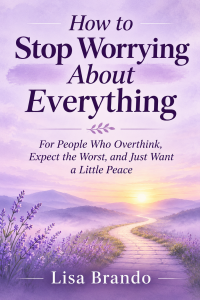
From The Finding Peace Series
How to Stop Worrying About Everything
For people who overthink, expect the worst, and just want a little peace. My book explores everyday worries, persistent what-if thoughts and ways to approach life with greater compassion for yourself.
Does thinking realistically mean ignoring danger?
No. I would never tell someone to ignore a genuine problem because they are trying to worry less. Take legitimate concerns seriously, gather reliable information, and seek the help or professional advice they require.
Realistic thinking allows both truths to exist: difficult things are possible, and you do not know that the worst will happen. You can prepare appropriately without making an imagined outcome the center of your entire day.
When should you ask for professional help?
If negative predictions and worries are persistent, difficult to manage or interfere with relationships, sleep, work or daily activities, consider speaking with a healthcare provider or licensed mental health professional. Cognitive behavioral therapy is one established approach to addressing unhelpful thought patterns. A professional can help you decide what care is appropriate for your circumstances.
Seeking help isn't a sign that you've failed. It is a practical step toward taking care of yourself.
Frequently asked questions about expecting the worst
Why do I always think something bad is going to happen?
There can be many reasons, including stress, uncertainty, past experiences and habitual ways of interpreting situations. If the feeling persists or becomes disruptive, a qualified professional can help you understand what's contributing to it.
Is expecting the worst the same as being prepared?
No. Preparation involves taking reasonable steps in response to an identifiable risk. Expecting the worst involves assuming an unfavorable outcome before you have enough evidence to know what will happen.
Is catastrophizing a mental health diagnosis?
Catastrophizing describes a thinking pattern, not a diagnosis on its own. It can occur in different circumstances, including anxiety. A clinician can evaluate persistent or distressing symptoms.
What can I say to myself when I expect the worst?
Try: "This is a prediction, not a fact. I can consider other possibilities and take a sensible next step without knowing the outcome yet." Choose wording that feels honest to you rather than attempting to force yourself to believe everything will be fine.
How can I stop assuming bad news when someone does not respond?
Notice that a delayed response is a fact, while the reason for it is still unknown. Consider ordinary explanations and take a proportionate next step, such as checking in when appropriate. If you have a genuine safety concern, act on it promptly.
Do I have to think positively to stop catastrophizing?
No. The aim is a balanced view that acknowledges both risks and other possibilities. You do not need to pretend that everything will be fine in order to question a frightening prediction.
You don't have to live tomorrow's troubles today
Something difficult may happen in the future. Something wonderful may happen too. And many days will turn out to be ordinary. I want you to have the chance to experience those days as they unfold, rather than losing them to a fear of what might come next.
For more practical encouragement, read these free guides:
Find more peace - related free guides
Helpful, reliable resources
- NHS Every Mind Matters: Reframing Unhelpful Thoughts - identifying and questioning negative thinking patterns.
- NHS Every Mind Matters: Dealing With Change and Uncertainty - approachable ways to cope with uncertainty.
- National Institute of Mental Health: Do I Need Help? - guidance about when to seek professional support.

About Lisa Brando
Lisa Brando is the author of The Finding Peace Series, an artist, mother, grandmother, business owner and U.S. Coast Guard veteran. She began publishing her books at 64, drawing on her own experiences to encourage readers facing worry, guilt and major life changes.
This article offers general educational information and personal encouragement, not medical advice, diagnosis or a substitute for professional care.