How do you stop worrying about things outside your control?
Identify what you can directly change, what you can influence and what you cannot determine. Take a practical step where one is possible, then acknowledge the uncertainty instead of trying to solve it with more worrying. Return your attention to something meaningful you can do today. Accepting what you cannot control does not mean you don't care; it means recognizing the limits of your responsibility.
- Identify what you can change or influence.
- Choose one action you can take today.
- Accept that some outcomes are not yours to determine.

As a mother of six, grandmother and business owner, I know how difficult it can be to let go of worries about people I love, finances and the future. I can give advice, offer help and make decisions for myself. But I cannot make every decision for somebody else or guarantee that everything will turn out exactly the way I hope it will.
That can be a very uncomfortable truth to accept. Especially when the thing you're worried about matters deeply to you. I don't want to tell you to simply stop caring. I want you to consider whether worrying is giving you any more control than you had before.
Why is it so hard to stop worrying about things we can't change?
When we're frightened or uncertain, thinking through a problem can seem like a way to prepare. That can be helpful when we have choices to make. But when no further action is available, repeatedly examining the same situation can leave us feeling exhausted without bringing us any closer to a solution.
Imagine waiting for news about someone you love. You may have already reached out, made appropriate arrangements and done everything you reasonably can. There is still uncertainty. It is understandable to feel worried, but feeling worried for another hour won't necessarily change the news you receive.
The NHS distinguishes between practical problems you can address and hypothetical worries about things that are not currently solvable. Learning to recognize the difference can help you decide where to spend your energy.
Three levels of control: change, influence and acceptance
Things I can directly change: My next action, the words I choose, how I organize my tasks, and whether I ask for help.
Things I can influence: A conversation with a loved one, how I respond to a customer, how I prepare for an appointment, and whether I make a reasonable plan.
Things I cannot determine: Other people's decisions, the past, every future event, or the final outcome of circumstances involving many factors.
These categories are not always completely separate. You may be able to influence a situation without controlling its result. For example, you can support an adult child without making every choice for them. You can work hard on your business without guaranteeing tomorrow's sales.
6 ways to stop worrying about what you can't control
1. Identify the part that is actually yours to handle
Write down the situation and ask, "What part of this is my responsibility?" Be specific. If someone you love has a problem, perhaps you can offer to listen or help them find resources. That doesn't mean the entire problem is yours to solve. A useful boundary separates supporting someone from assuming responsibility for every outcome in their life.
2. Give yourself one useful action
If there is a realistic next step, choose it. If you're worried about an upcoming expense, reviewing your actual budget may be useful. If you're concerned about a health issue, getting appropriate medical advice may be the next step. Decide what you can do and when you will do it. Avoid postponing genuinely urgent actions.
3. Recognize when thinking stops helping
Ask yourself whether your last ten minutes of worrying produced a new fact, a new option or a workable plan. If not, you may be going over the same ground. You do not have to wait until you feel completely certain before turning your attention elsewhere. If you find yourself imagining disasters, read how to stop expecting the worst.
4. Stop making yourself responsible for other people's decisions
It is especially hard when we love someone. We may believe that if we say the right thing, worry enough or keep reminding them, we can make everything turn out well. We can offer care and honest advice, but other adults have choices of their own. Respecting that distinction can be painful and still be necessary.
5. Make space for the feeling without demanding a solution
Acceptance does not mean pretending a problem is unimportant. You may feel sad, angry, frightened or disappointed about something you cannot change. Letting yourself acknowledge the feeling can be more honest than insisting you must not feel it. Consider talking to someone you trust instead of carrying the worry alone.
6. Return to something that belongs to today
Choose an ordinary activity that matters to you: prepare a meal, finish one small task, read a few pages, or spend time with someone you love. You are not abandoning your concern by living the rest of your day. You are recognizing that there is more to your life than the one situation you cannot resolve.
Try this control and influence worksheet
Choose one situation that has been occupying your mind. Use the five prompts below to sort what you can control, what you can influence and what is outside your control.
Situation: I'm worried about my business having a slow month.
Control: I can review expenses, prioritize productive work and check my website links.
Influence: I can improve the customer experience and promote my business.
Outside my control: I cannot guarantee how many people will buy something tomorrow.
Today's action: Choose one helpful task, complete it and review the results at a sensible time.
Your answers are not submitted or saved by this worksheet. Print a copy if you want to keep them.
Try the exercise with a relationship concern, an upcoming decision, or a worry about the past. There may be no immediate action, and that is a valid answer too.
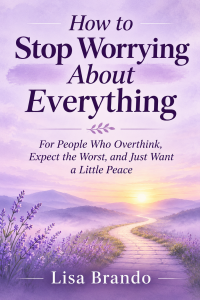
From The Finding Peace Series
How to Stop Worrying About Everything
For people who overthink, expect the worst, and just want a little peace. Find more practical reflection exercises and encouragement for navigating everyday worries.
What if the thing I can't control really is serious?
Not every worry is an exaggerated fear. Some of life's hardest experiences involve real loss, financial hardship, illness or circumstances that do not improve simply because we think differently. It is important to recognize genuine risks and seek help where appropriate. Acceptance does not mean ignoring a danger, refusing assistance or giving up on a change that is possible.
Sometimes the most useful action is to ask for support, obtain reliable information or take a necessary precaution. When the outcome still remains uncertain, you can give yourself room to cope with the situation without expecting yourself to control it completely.
When worry is taking over your life
If worrying feels difficult to control, affects your sleep, interferes with relationships or work, or makes everyday tasks increasingly difficult, speak with a healthcare provider or licensed mental health professional. Persistent anxiety deserves care, and effective treatments are available. There is no shame in needing more support than a self-help article can provide.
Frequently asked questions
Does letting go mean giving up?
No. Letting go means recognizing the limit of your control. You can continue working toward a goal, supporting someone or addressing a problem while accepting that you cannot guarantee the outcome.
How do I stop worrying about my adult children?
Consider what they have asked of you, what help you can reasonably offer and what decisions belong to them. Keep communication open and take genuine safety concerns seriously without assuming you must manage their entire lives.
How do I stop worrying about the past?
Look for any meaningful lesson, repair or action available today. If an event cannot be changed, acknowledge the feelings it brings up and consider speaking with someone supportive. Repeatedly punishing yourself does not rewrite the past. Read my guide to making peace with past mistakes.
What can I tell myself when I can't control the outcome?
Try: "I can do my part without knowing exactly how this will turn out. I have made a reasonable plan, and I can return to it when there is new information."
How do I let go when I am waiting for an answer?
Decide if there is an appropriate follow-up you can make. If there is nothing more to do right now, choose a time to check again and spend the intervening time on an activity that matters to you. Urgent concerns deserve timely action.
Why does accepting uncertainty feel so uncomfortable?
Not knowing can be difficult, particularly when a situation matters to you. Acceptance is not an instant change in how you feel. It can start with acknowledging that you do not have the answer yet and noticing which next step is actually available.
You can care without carrying everything
I want you to remember that you are not responsible for every outcome in the world. You are responsible for the choices that are yours to make. There is a difference, and learning to recognize it may give you a little more room to enjoy the life you have today.
Continue reading my free Finding Peace guides:
- How to Stop Worrying About Everything
- How to Stop Overthinking at Night
- How to Stop Expecting the Worst
Find more peace - related free guides
Helpful, reliable resources
- NHS Every Mind Matters: Problem Solving - recognizing practical problems and worries you cannot directly resolve.
- NHS Every Mind Matters: Tackling Your Worries - practical ways to approach worry.
- National Institute of Mental Health: Generalized Anxiety Disorder - information on symptoms, treatment and seeking support.

About Lisa Brando
Lisa Brando is the author of The Finding Peace Series, an artist, mother, grandmother, business owner and U.S. Coast Guard veteran. She began publishing her books at 64, drawing on her own experiences to encourage readers facing worry, guilt and major life changes.
This article offers general educational information and personal encouragement, not medical advice, diagnosis or a substitute for professional care.